The Global Banking School (GBS) has expanded significantly in recent years, opening new campuses across London, Manchester and Birmingham, as well as international sites in Dubai and Malta.
In 2021 they opened their first site in Leeds at the St George House campus. They have since taken on a second building and student numbers have risen from around 1,000 to approximately 5,000 across Leeds.
We visited the campus to meet Lewis Oswin-Bateman, Facilities Manager, and John Ward, Regional Facilities Manager, to learn about system reliability, how the network is contributing to the student experience, and what sustainability means to them.
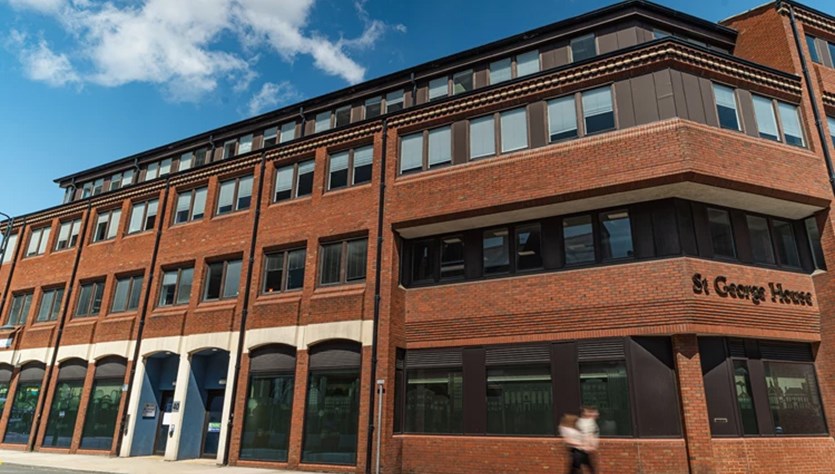
St George House was connected to the Leeds PIPES heat network in 2019 and the heating system has proven to be a reliable, low-maintenance solution.
Can you tell us about how you came to be connected to the Leeds PIPES heat network?
John: As a company, we’ve expanded significantly throughout the UK and added international sites. We wanted a presence in Leeds and in 2021 we entered a 15-year lease with the Council for the building. The Council had already connected the building to Leeds PIPES, so the pipework was in place and the plant room finished.
Is it important to GBS to have sustainable solutions for energy and did Leeds PIPES fit into that?
John: It’s the way GBS want to go, and the heat network offers that to them. As a business, we tend to do 15-year leases, so undertaking the connection ourselves for a limited period may not have made business sense, but because it was already installed, it was a good solution for us.
As leaders, we need to demonstrate that we want to save energy. When we have to produce, we should ask ourselves, “can we look at better ways of producing that?”
Lewis: What’s interesting is that the district heating network is renewable. The heating comes from the Energy from Waste plant, and I organised a site visit so I could understand more about where the heat comes from. I think the Leeds PIPES project is an amazing initiative and comparing it to our other site in Leeds, which is gas, you’ve got a lot less compliances as well, with things like gas servicing. Also, there’s no combustion, so it’s a lot safer on that side of things.
Can you compare the benefits of being connected to a heat network with your other sites which use gas boilers?
Lewis: For me, as someone who has to handle all the heating, it’s no hassle. Compared to managing the boilers and all the fan coil units down at our other site, I have more stress there than I do here. This system is a lot easier to think about and fix.
John: It’s the reliability that’s great. The water comes into the building, goes through the plate heat exchanger, through the building pipes and back out. You really can’t get much simpler than that. It’s ideal for hospitals, universities and organisations which can’t have downtime and I’d say it’s proved its worth here.
So, as well as simplicity, it’s also about reliability.
Lewis: It’s one less thing to think about. I know if this system ever went off, I could give Vital Energi a ring and someone would come out and fix it. It’s about reliability and we know that heating is going to be there.
John: We’re five winters’ in with Leeds PIPES and we’ve never had a major issue with the heating. From my experience, if it was a gas boiler, we’d have had at least one instance where we came into a freezing cold building because the system had gone down.
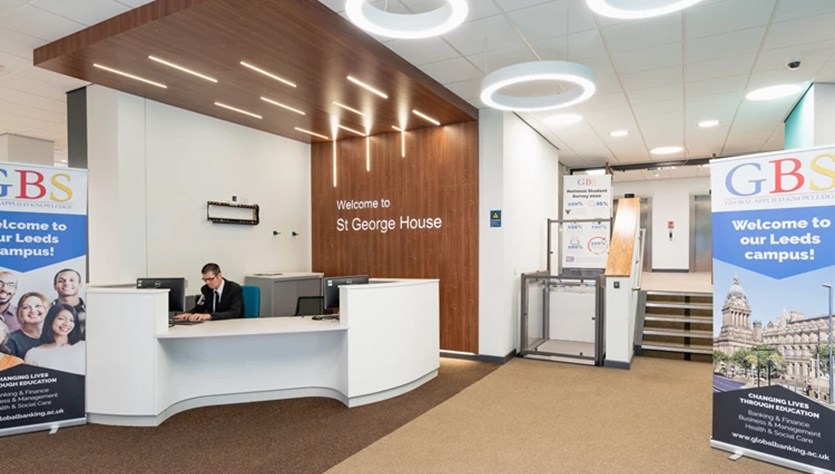
The Leeds PIPES heat network takes renewable heat from the nearby RERF and distributes it to customers around Leeds, including The Global Banking School.
How does maintenance of a heat network stack up against fossil‑fuelled solutions?
John: I think it’s a lot better. We’ve had one minor issue which was rectified and didn’t affect performance, and we’ve been in the building five years. This is opposed to situations where we’ve taken over a building and then we’ve got to get the servicing of the boilers and practical things like that. These can be coming up to the end of their lifecycle and need replacing, but the plate heat exchangers are simpler.
Lewis: From our perspective, all we do is treat the heat exchangers like boilers. All the pump systems, all the Building Management System settings are the same, so that side of things is fairly familiar.
John: Vital just come out once a year for an inspection.
How’s the responsiveness when you report an issue?
John: We’ve got a contact number so any issues we can just call that. We had an engineer in from another company who’d accidentally hit the “stop” button instead of the light switch on their way out of the plant room. A Vital engineer came, realised that had happened and got the system going again.
You’ve grown as a business, so presumably the way you use energy has changed. How does the system meet the increased needs?
Lewis: In total, between here and our other site we’ve grown to around 5,700 students.
John: And because we’re not a typical university, we have three intakes a year. When we first opened this in 2021 people were coming in and doing four-year courses, but they were part-time and only did two days per week and they tended to be staggered. We’ve also increased opening times from five days to seven days per week.
Has the system been able to accommodate that increase?
John: Yes. We’re looking to get maximum use out of the building, so in those really cold months - December, January, February - the heating will be on constantly, and it meets those needs. We want student comfort, so we make sure it’s between 20 and 23 degrees.
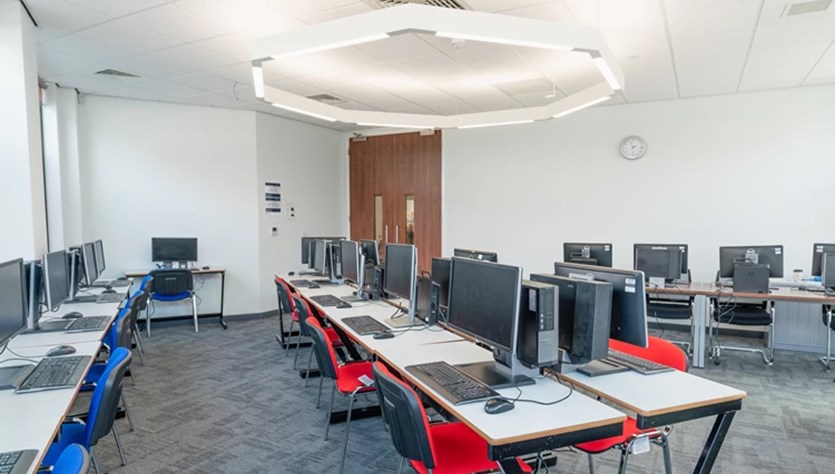
St George House was the Global Banking School's first presence in Leeds. They have since opened a second campus and student numbers have grown to over 5,000.
How important is sustainability for your students and what does it mean to know they get their heat from a renewable source?
John: Any time you can reduce your energy usage or carbon by a percentage, it has to be worthwhile. Not all countries are as committed as we are, but we can show the students that we’re doing our bit, as a company, and we can look at it from a global perspective because we’re a global company.
The students are onboard with that.
Lewis: We have construction management courses, and those students are really in tune with how we’re going to have to be more sustainable going forwards. They’re very technically knowledgeable and they’re the ones who come to us and ask direct questions about our sustainability. We can talk to them about things like our waste management contract and how 100% of waste is diverted from landfill. The Leeds PIPES connection is part of that.
Are you looking to improve the building further
John: We’re currently updating the radiators, which are probably from the mid‑1980s, when it was built, and that will make the heating more effective.
Lewis: What we need to balance is that we take 15-year leases, so our investments reflect that, but we’ll explore any solution if we think it benefits us and makes us more sustainable, from assessing solar and the Building Energy Management system, to the possibility of taking our hot water from Leeds PIPES as well as heating.
